


For years my brother and I served clients from our marketing agency. Tour operators in Cancún, transfer companies in the Riviera Maya, shops, service providers. Real businesses, with real volume and customers waiting for an answer.
And in almost every one of them, the same picture.
The operation lived scattered across a spreadsheet only one person understood, a WhatsApp group where the day's departures were coordinated, a notebook with the payments, and some standalone system that talked to none of the others. The owner had no idea in real time how much had been collected this month. When someone asked about availability for the weekend, you had to check three different places and trust the memory of whoever picked up the phone.
The important part is that this was not carelessness. These people know their industry better than anyone and have spent years growing their business the hard way. What they did not have was a tool built for them.
The software existed, just not for them
Every time we looked for something to recommend, the same two options showed up.
One: serious, powerful platforms built for large companies with an in-house technical team, an implementation budget and someone to administer them. Out of reach for a fifteen-person business.
Two: generic solutions that solved a very small slice of the problem. A booking engine here, a CRM there, a payment gateway somewhere else. The client ended up with four subscriptions that still did not talk to each other, which is exactly the problem they were trying to escape.
Underneath it all, the same question kept coming back between projects: why is there no platform designed from scratch so that a mid-sized business can run professionally, without hiring developers and without maintaining servers.
From conversation to code
That question hung around for a good while. Between clients, between projects, in work conversations that turned into family conversations.
Until it became something else: let's build it ourselves.
I come from the technical side, so shaping it fell to me. The architecture, the foundational decisions you cannot undo later, the first working product. We started with tourism because it was the market closest to us and where the pain needed no explanation: a badly coordinated departure costs you the same day, with customers waiting on the sidewalk.
My brother joined once the foundation was standing, and he brought what a technical project always lacks. The customer's point of view, the strategy to reach the market and, above all, a wider horizon than the one I was looking at: the same problems, scattered operations, tools that do not scale, no real control, show up in a real estate business, a clinic or any service company. The platform did not have to stay in tourism.
That is when Vorm stopped being my project and became what we had always pictured in those conversations.
What it is and what it is not
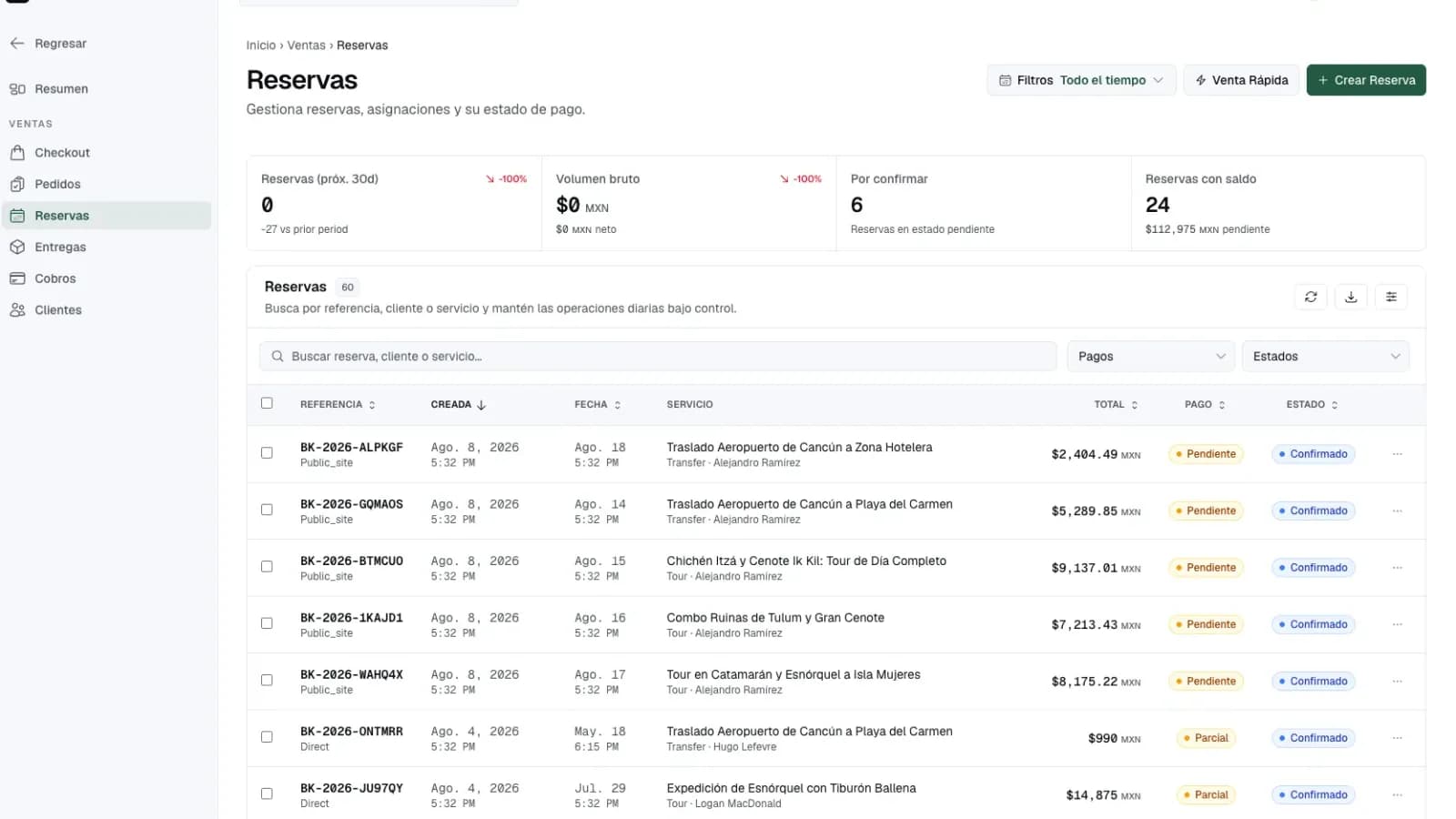
Vorm is the infrastructure to run a business from one place. Service catalogue, customers, bookings, payments, the day's operation with its guides and vehicles, the portal for trade partners and even the business's public site. All connected, in real time, with no technical team behind it.
It is worth saying what it is not, too. It is not a booking engine. It is not a CRM. It is not a website. It is what large companies commission as custom software, ready to use for the ones who cannot pay for that.
The first industry in production is tourism. The rest will come as the platform grows.
Where the name comes from
Vorm has roots in two languages. In Dutch, vorm means form or mould. In German, vor means before, or ahead.
Both ideas are in what we want it to be: the form a business shapes its operation around, and the before and after of the road that leads from working with patches to working with control.
How we will know it worked
This is the part I am clearest about, and the one I repeat every time we argue over a product decision.
Success is not how many users we have, nor how much the company grows, nor how elegant the technology underneath is. It is whether our clients operate better than before. Whether they lose less money to mistakes that were avoidable. Whether they sleep better knowing where their business stands.
Everything else serves that. And after years of seeing the same problem on the table at so many clients, it is the only thing I find worth measuring.